What is a Hydrogen Car and How Does It Work?
Hydrogen cars use hydrogen as an energy source instead of fossil fuels. There are two main types:
- Fuel Cell Electric Vehicles (FCEV) work with a fuel cell that converts hydrogen into electricity through an electrochemical reaction with oxygen. They are efficient vehicles that achieve a range of 500-800 km and generate 0 emissions, as they only produce water vapor. Their operation is very similar to that of an electric car, but without the need for large batteries.
- Hydrogen internal combustion vehicles use hydrogen as fuel in a modified combustion engine, similar to gasoline engines. Unlike FCEVs, they emit some nitrogen oxides (NOx) but no CO₂.
Which Manufacturers have developed hydrogen cars?

Several automakers have invested in hydrogen technology, with some producing commercial models:
- Toyota – Mirai: One of the most well-known FCEVs, offering a long range and advanced hydrogen technology.
- Hyundai – Nexo: A second-generation FCEV with cutting-edge technology and high efficiency.
- Honda – Clarity Fuel Cell: Previously available in select markets, but production has been discontinued.
- BMW – iX5 Hydrogen: A hydrogen-powered SUV prototype in limited production.
- Mercedes-Benz – GLC F-CELL: A plug-in hybrid FCEV that combines a fuel cell with a small battery.
While hydrogen mobility is still in development, these manufacturers continue to explore its potential, particularly for heavy-duty vehicles and long-range applications.
Refueling time and range of a hydrogen cars
A hydrogen fuel cell vehicle (FCEV) takes between 3 to 5 minutes to fully refuel, similar to a gasoline or diesel vehicle. In contrast, electric cars require 30-40 minutes with a fast charger and several hours with a home charger.
For passenger cars, hydrogen is stored at 700 bar (70 MPa), with tanks holding 5-6 kg of H₂, providing a driving range of 500-700 km.
Electric, Fossil Fuel, or Hydrogen Vehicles?
If we strictly consider sustainability and take into account the entire value chain of energy sources and raw materials required for their development, hydrogen vehicles are the most sustainable, while fossil fuel vehicles are the most polluting. It is important to remember that a hydrogen car, as long as the hydrogen comes from a renewable source, only emits water vapor into the atmosphere. On the other hand, electric cars also have zero emissions during use, but the electricity they rely on is not always generated from renewable sources, and lithium extraction for batteries has a significant environmental impact.
From a consumer perspective, both electric and hydrogen cars face several challenges that currently limit their widespread adoption. While electric cars have an advantage in the consumer market, their main drawbacks include: high cost, limited charging infrastructure and range, long charging times, and environmental concerns related to battery production.
As for hydrogen cars, since this technology is still in development, several key obstacles remain:
- Lack of refueling stations
- High cost (for example, a Toyota Mirai costs around €70,000)
- Lower energy efficiency (considering the energy required to produce, compress, and store renewable hydrogen)
- Maintenance costs
- Complex and expensive hydrogen transportation and storage
Overcoming these challenges will be essential for the large-scale adoption of hydrogen-powered vehicles.
Is There a future for Hydrogen Vehicles?
For passenger cars, hydrogen faces significant competition from electric vehicles. However, hydrogen has a promising future in heavy transport (buses, trains, trucks, ships, and airplanes) due to advantages such as: longer range, fast refueling, better energy-to-weight ratio, superior performance in extreme conditions and less impact on the electrical grid
The future of hydrogen in passenger vehicles depends on technological advancements and cost reductions driven by economies of scale.
Valves and Components in a Hydrogen Fuel Cell System
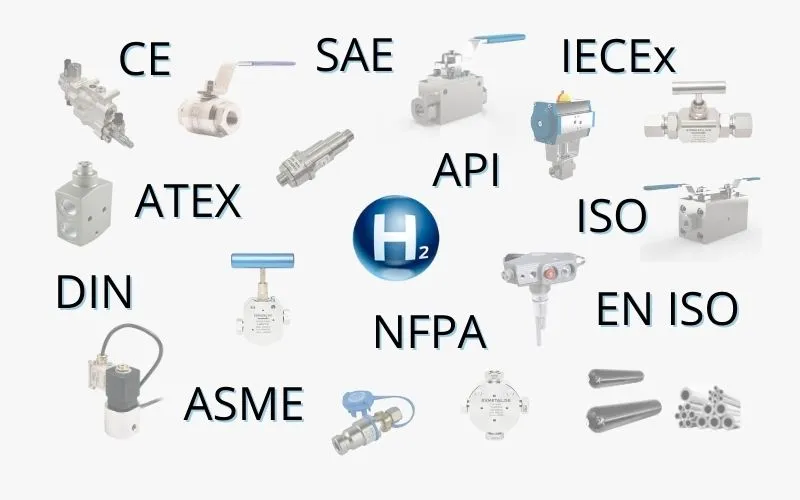
Safety is undoubtedly one of the most concerning aspects when discussing hydrogen vehicles. For this reason, their design incorporates a complex system of valves and components made of 316/316L stainless steel, ensuring the system’s sealing and safety.
One of the key parameters in any hydrogen system is pressure. As hydrogen travels from the vehicle’s intake to the fuel cell, it undergoes two decompression stages. In the first stage, pressure is reduced from 350 bar or 700 bar (depending on the type of FCEV) to 14-17 bar using a pressure regulator. Then, in the second stage, it is further reduced to below 1 bar before entering the fuel cell.
In addition to the fuel cell, battery, hydrogen tanks, and control systems, hydrogen vehicles incorporate a wide range of valves and components, including: filling receptacle valves, solenoid valves, shut-off valves, tank valves, check valves, pressure regulators, pressure and temperature sensors, flow regulators, and multiple safety devices. These components protect the system from potential overpressure or overheating, safely venting hydrogen through a release port if necessary.
At LEXIER, our partnership with OMB Saleri, a global leader in hydrogen mobility solutions, allows us to provide a Complete Range of Certified Valves and Components for Hydrogen Vehicles, complying with UNE-EN ISO 17268, EC79, and UNECE R134 standards.