In this hydrogen valve guide, we look at the key valve types, standards and materials that ensure safety and efficiency in every process across the entire hydrogen value chain: production, storage, distribution, dispensing, end use and mobility.
Hydrogen is gaining ground as a key energy carrier in the transition to a decarbonised economy. However, handling it poses very specific technical challenges, especially for critical components such as valves.
1. Technical challenges of hydrogen: why are special valves required?
Hydrogen has unique properties that pose significant challenges for the design and selection of suitable valves. These challenges call for specific solutions to ensure safe, efficient and durable handling. That is why hydrogen valves must meet unique requirements for leak tightness, resistance to embrittlement and chemical compatibility.
Extremely small molecular size
Hydrogen is the smallest and lightest molecule, so it easily escapes through microscopic pores or imperfections in conventional materials. This increases the risk of leaks, even in closed systems.
Key requirement: valves with hermetic seals and low-permeability materials to prevent losses and maintain system integrity.
High flammability and ignition risk
Hydrogen is highly flammable and can be ignited by very small ignition sources, such as sparks or electrostatic charges. This makes even the smallest leak a critical safety risk.
Essential: valves certified to strict safety standards, with antistatic materials and mechanisms that minimise leakage.
Extreme operating conditions
Hydrogen may be handled as a compressed gas at pressures of up to 1000 bar, or as a liquid at cryogenic temperatures close to -253 °C.
Required: valves that keep their structural and functional integrity under these extremes, ensuring leak tightness and resistance to thermal and mechanical variations.
Material compatibility and resistance
Choosing the right materials is essential for safe and efficient valve performance in hydrogen systems. This decision must take several critical factors into account:
- Chemical compatibility: materials must be chemically stable and must not react with hydrogen or any impurities, to avoid degradation, corrosion or contamination of the system.
- Mechanical strength: components must withstand high operating pressures and repeated opening and closing cycles without deformation, fatigue or structural failure.
- Hydrogen embrittlement: this occurs when certain metals absorb hydrogen and lose ductility, becoming brittle and prone to fracture. For this reason, embrittlement-resistant materials are preferred, such as austenitic stainless steels (e.g. AISI 316L) and special alloys designed for hydrogen service.
- Leak tightness: materials must allow a hermetic seal, minimising any leakage even under extreme pressure and temperature conditions.
- Long-term safety and durability: materials must ensure reliable performance throughout the valve’s service life, resisting corrosion, wear and chemical attack to maintain system integrity and safety.
2. Recommended materials for valves in hydrogen environments
ISO 11114-1/2 sets out the compatibility of metallic and non-metallic materials with compressed hydrogen. Below we review the compatible materials under this standard for each valve component:
Valve body
- AISI 316L / 316Ti: high corrosion resistance and good H₂ compatibility.
- 1.4404 / 1.4571 (EN): low-carbon European equivalents.
- Duplex steels (22Cr/5Ni): higher mechanical strength without losing corrosion resistance.
- Inconel, Hastelloy: for extreme conditions and pressures above 700 bar.
Avoid: untreated carbon steels or alloys prone to internal corrosion.
Ball or closure element
- AISI 316L with Cr₃C₂ or Ni-Cr coating: greater hardness and abrasion resistance.
- Monel / Inconel: recommended for critical high-pressure valves.
Gland and moving parts
- 316L or 17-4PH: high mechanical durability.
- Coatings: titanium nitride (TiN) or hard chrome to reduce wear.
Sealing elements
- PTFE (Teflon): for moderate conditions only.
- PCTFE (Kel-F): a better H₂ barrier than PTFE.
- PEEK: excellent chemical and thermal resistance.
- FKM / FFKM (Viton®, Kalrez®): use only if hydrogen-compatible.
Avoid: NBR, EPDM or materials not certified for hydrogen service.
3. Standards and regulations for hydrogen valves
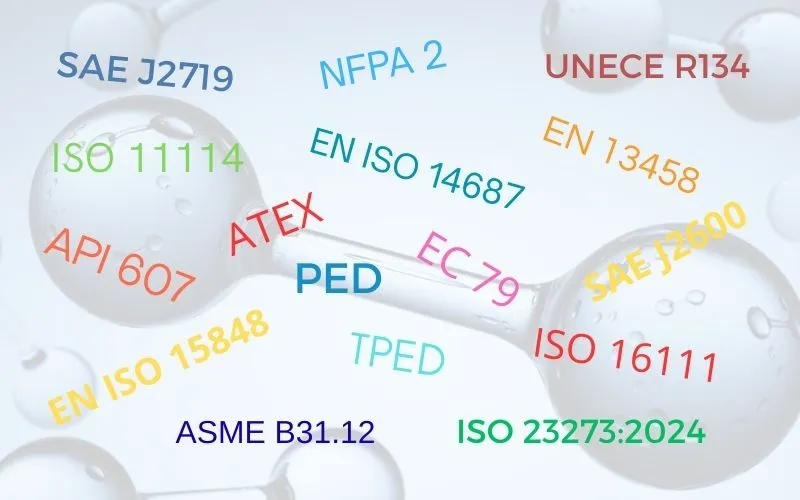
Regulatory compliance is essential to ensure the safety and performance of valves used in hydrogen systems. Although there are many specific international standards, below is a basic summary of the most relevant ones.
Main standards:
- ISO 19880-3: specific requirements for hydrogen fuelling station components, including valves.
- ASME B31.12: key standard for hydrogen piping and pipeline systems (high pressure and purity).
- ISO 11114-1/2: material compatibility with hydrogen.
- PED/TPED Directives: mandatory in the EU for pressure equipment.
- ISO 15848 (CO1/CO2): fugitive emissions certification, critical to prevent hydrogen losses (a highly permeable gas).
- ATEX and Fire Safe: essential in explosive atmospheres or where there is a fire risk.
- ISO 21012: cryogenic valves (liquid hydrogen).
- EC 79/2009 and SAE J2579: type approval for fuel cell vehicles.
The BEQUINOR Hydrogen Safety Guide provides regulatory criteria and good practice for hydrogen equipment and installations.
👉 Download the guide (PDF, in Spanish)
4. What types of valves are used in hydrogen systems?
Now that we understand the main technical challenges of hydrogen, let’s look at the types of valves used in hydrogen systems by function, that is, by the role they play at a given stage of the hydrogen process.
The table below shows the main valve types, the most common designs for each and some relevant technical considerations.
| Type | Function | Design | Considerations |
|---|---|---|---|
| Shut-off valves | Fully open or close the flow | Ball, needle | Always choose high-quality valves that ensure leak tightness, with soft seats (PTFE, PEEK) or precision-machined metal-to-metal seats. |
| Control valves | Precisely control hydrogen flow and pressure | Needle, diaphragm | Require regular maintenance to keep their accuracy and avoid drift. |
| Check valves | Prevent hydrogen backflow | Spring, piston, ball | Select models with the lowest possible cracking pressure to avoid pressure drop and improve the system’s energy efficiency. |
| Safety/relief valves | Release the fluid in a controlled, gradual or full way in case of overpressure | Pilot-operated, rupture disc, diaphragm, spring | Must be precisely calibrated and meet strict standards (e.g. PED, ASME, ISO). |
| Solenoid valves | Open or close hydrogen flow by electrical control | Direct-acting, pilot-operated | Require ATEX rating in explosive atmospheres. Ideal for automation and remote control. Check electrical compatibility and working pressure. |
5. What technical criteria should you consider when choosing hydrogen valves?
Beyond function and design, a number of technical criteria must be considered when deciding which valve is best suited to each process.
The table below compares the most important selection criteria:
| Criterion | Recommendation for H2 systems |
|---|---|
| Operating pressure | From 30 to 1000 bar, depending on the application (low, medium or high pressure) |
| Temperature | Varies by application; for compressed gas it typically ranges from -40 °C to +85 °C. Consider cryogenic applications: around -253 °C for liquid hydrogen (LH₂). |
| Connection type | Flanges, NPT/BSP threads, orbital welding or double-ferrule compression fittings (instrumentation) |
| Body material | 316L stainless steel, Inconel, Hastelloy or other H₂-compatible, embrittlement-resistant materials |
| Certifications | ISO 19880-3, ASME, CE/PED, TPED, ATEX (where explosive atmospheres apply), fugitive emissions, Fire Safe, SIL |
| Leak tightness | Metal seats or PTFE-insert seats; must pass helium or hydrogen leak tests |
6. Valve types and standards for each application in the hydrogen value chain
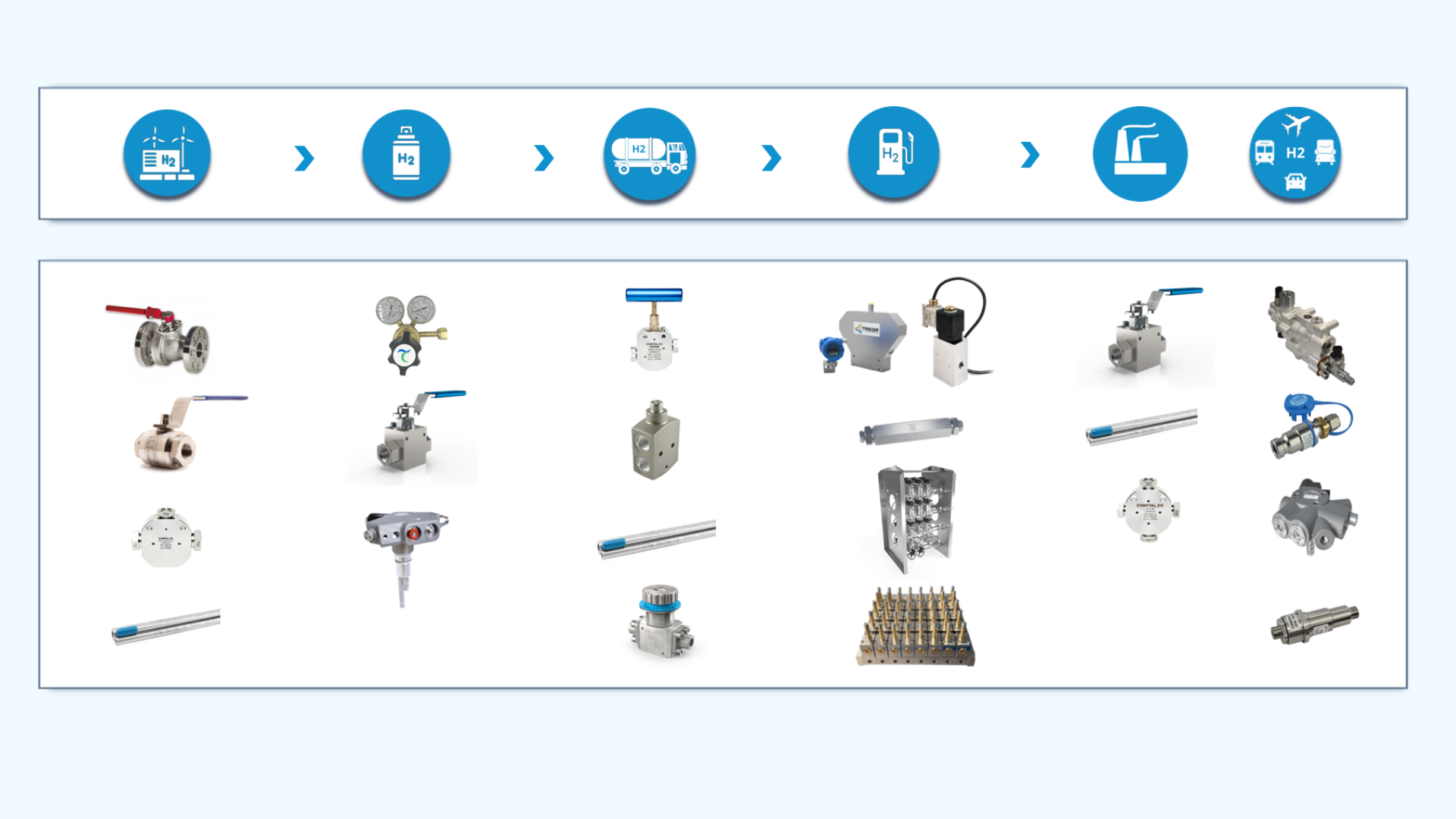
Hydrogen production:
- Technical requirements: high leak tightness, resistance to corrosive mixtures and variable pressures from low to medium (0.5 to 50 bar) depending on the process.
- Recommended valves: needle valves (for fine control), check valves (to prevent backflow), pressure regulators, flow regulators.
- Applicable standards: ISO 19880 (gaseous H2 safety), ASME B31.12 (H2 piping), CE/PED (Pressure Equipment Directive), API 622 (valve leak testing), ISO 15848-1 (fugitive emissions), ATEX where there is a risk of explosive atmosphere.
Hydrogen storage:
- Technical requirements: high pressure (200–900 bar for compressed gas) and extreme temperatures for liquefied hydrogen (LH2), down to -253 °C.
- Recommended valves: safety, relief and cryogenic valves.
- Applicable standards: ISO 19880-3, TPED, CE/PED.
Hydrogen distribution:
- Technical requirements: reliability, low pressure drop and leak tightness at high pressure, typically in the 200 to 700 bar range.
- Recommended valves: ball, check and safety valves.
- Applicable standards: ISO 19880, TPED, CE/PED, ASME B31.8S, API 6D.
Hydrogen dispensing:
- Technical requirements: operating pressure up to 950 bar (for 700 bar refuelling), high reliability, safety and leak tightness.
- Recommended valves: check valves, safety valves and fast shut-off valves (needle valves and solenoid valves).
- Applicable standards: ISO 19880-1/3, SAE J2601, SAE J2799, ISO 17268, CE/PED.
Hydrogen mobility:
- Technical requirements: light weight, vibration resistance, compact valves and operation at pressures between 350 and 700 bar.
- Recommended valves: ball valves, needle valves, check valves, safety valves, pressure regulators, on-tank valves, thermally activated pressure relief devices (TPRD).
- Applicable standards: ISO 19880, EC79/2009, GTR No. 13, ECE R134, UNECE R136, SAE J2600.
Industrial processes:
- Technical requirements: high duty cycles, low maintenance, high leak tightness and operation at variable pressures, commonly between 50 and 200 bar.
- Recommended valves: ball valves, needle valves, solenoid valves, pressure regulators, flow control valves, check valves and safety valves.
- Applicable standards: ASME B31.12, CE/PED, ATEX, IEC 60079, API 607.
How can Lexier help you?
As we have seen, industrial valves play a key role at every stage of the hydrogen cycle. Choosing the right type not only improves performance but also ensures regulatory compliance and safety. At LEXIER, we offer a wide range of certified valves and components for every hydrogen application.
▶️ Certified valves for hydrogen.
▶️ Leading brands for critical applications and extreme industrial environments.
▶️ Tailored technical advice for your project and the applicable standards.
🔍 Explore our hydrogen product range
📩 Got a project? Let’s talk